- Testosterone usually declines slowly - roughly 1% a year from your 30s - so the changes are easy to miss.
- The tell is a cluster of symptoms at once: low energy, low drive, poor recovery, brain fog, low mood and broken sleep.
- Many of those same symptoms have other causes, so the only way to confirm low testosterone is a morning blood test.
- Sleep, strength training, body composition, stress and key nutrients (vitamin D, zinc, magnesium) all support healthy levels.
Testosterone does not fall off a cliff. For most men it drifts down slowly - often around 1% a year from the age of 30 onward - which is exactly why the changes are so easy to miss. There is no dramatic moment, just a growing sense that your energy, drive and recovery are not what they used to be, and a quiet assumption that this is simply "getting older".
Sometimes it is just ageing. But often it is a pattern worth paying attention to. This guide covers the signs men over 40 most commonly notice, what else could be causing them, when to get tested, and the lifestyle levers that genuinely support healthy testosterone.
What testosterone actually does
Testosterone is central to far more than libido. In men it supports muscle mass and strength, bone density, fat distribution, red blood cell production, motivation and mood, mental sharpness, and of course sex drive. It also interacts closely with sleep and stress. Because it touches so many systems, when levels drift low the effects rarely show up in just one place - they tend to appear across several at once.
The common signs of low testosterone over 40
Low energy and afternoon crashes
A flat, "running on empty" feeling that coffee does not fix - often with a hard crash in the early afternoon. It is one of the first things men notice.
Reduced drive and libido
Lower interest in sex, and sometimes weaker morning erections. Drive is downstream of healthy testosterone, good sleep and manageable stress, so it is often the first domino to fall.
Slower recovery and stalling strength
Workouts that used to leave you energised now leave you sore for days, and progress in the gym stalls or slips despite consistent effort.
Brain fog and low mood
Trouble focusing, a shorter fuse, and a general dip in motivation and drive. Testosterone has a real influence on mood and mental clarity.
Poor or broken sleep
Lighter, more fragmented sleep - which then feeds the problem, since much of your testosterone is produced overnight. Sleep and testosterone decline together in a loop.
More belly fat
Weight that settles around the middle despite eating as you always have. Body fat and testosterone influence each other, so this can become self-reinforcing.

Why the cluster matters
Any one of these symptoms has plenty of innocent explanations. Low energy could be poor sleep or stress. Low drive could be relationship or mood factors. Belly fat could be diet. On their own, none of them points clearly to hormones.
It is the cluster - several of these building together over months - that suggests testosterone may be part of the picture rather than a single bad week. If three or four of the signs above describe you, it is worth looking closer.
When and how to get tested
If the signs are stacking up, the only way to know your actual level is a blood test. A few practical points:
- Test in the morning. Testosterone follows a daily rhythm and is highest in the early morning, so that is when it should be measured.
- Ask for total and, ideally, free testosterone. Free testosterone is the portion actually available to your body.
- Rule out other causes. A good doctor will also check things like thyroid function, which can mimic low-testosterone symptoms.
- Supplements are not a substitute for that conversation. If your levels are genuinely low, that is a medical issue to manage with your doctor.
How to support healthy testosterone naturally
For most men, the biggest gains come from the basics - and they are worth doing whether or not you ever supplement.
Protect your sleep
Deep sleep is when most of your testosterone is produced. In one JAMA study, restricting healthy young men to five hours of sleep for a week lowered daytime testosterone by 10-15% (Leproult & Van Cauter, 2011). Seven to nine consistent hours is foundational.
Lift weights
Resistance training - especially big compound lifts - is one of the most reliable ways to support healthy testosterone. Keep it challenging, but avoid chronic overtraining, which raises cortisol.
Mind body composition and stress
Excess body fat, particularly around the middle, is linked with lower testosterone, and even modest fat loss can help. Chronic stress keeps cortisol elevated, which works against testosterone - so sleep, training and genuine downtime all matter.
Get the key nutrients
Deficiencies are common and worth correcting. Vitamin D is linked with testosterone, and supplementation has been associated with higher levels in men who were low (Pilz et al., 2011). Zinc contributes to normal testosterone, and correcting a deficiency can support healthy levels (Prasad et al., 1996). Magnesium supports sleep and recovery. Ashwagandha root extract has been studied for strength and testosterone alongside training (Wankhede et al., 2015).
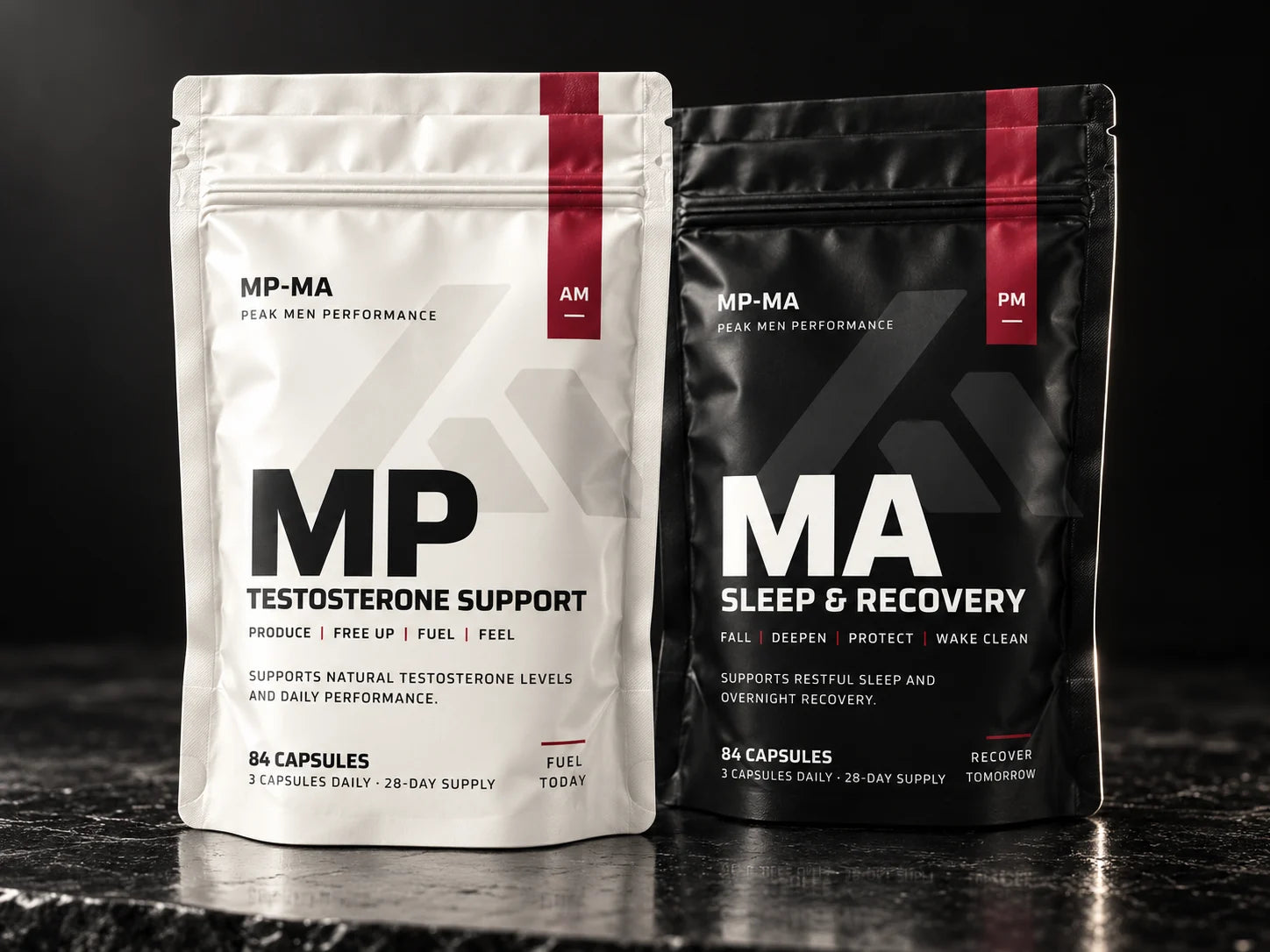
Where MP-MA fits
MP-MA supports both ends of this picture. The morning formula, MP, delivers clinically-studied actives - including vitamin D3, zinc, ashwagandha and more - for daytime energy, focus and healthy testosterone. The melatonin-free evening formula, MA, supports the deep sleep and overnight recovery where testosterone is made. Every dose is printed on the label. See the full breakdown on our science page or explore the MP-MA Day & Night System.
Frequently asked questions
At what age does testosterone start to drop?
For most men, gradually from around age 30, by roughly 1% a year - so it is usually noticeable by the 40s.
Can I raise testosterone naturally after 40?
Sleep, strength training, managing stress and correcting nutrient gaps can all help support healthy levels. Severe deficiency is a medical issue - see your doctor.
Should I get a blood test?
Yes, if several signs are stacking up. A morning total (and ideally free) testosterone test is the only way to know your real level.
Are low-testosterone symptoms reversible?
Symptoms driven by poor sleep, stress, inactivity or nutrient gaps often improve when those are addressed. Clinically low testosterone should be managed with a doctor.
Sources
- Leproult R, Van Cauter E. Effect of 1 week of sleep restriction on testosterone levels in young healthy men. JAMA. 2011. PubMed
- Pilz S, et al. Effect of vitamin D supplementation on testosterone levels in men. 2011. PubMed
- Prasad AS, et al. Zinc status and serum testosterone levels of healthy adults. Nutrition. 1996. PubMed
- Wankhede S, et al. Examining the effect of Withania somnifera (ashwagandha) on muscle strength and recovery. J Int Soc Sports Nutr. 2015. PubMed
- NIH Office of Dietary Supplements. Vitamin D - Health Professional Fact Sheet. ods.od.nih.gov
- NIH Office of Dietary Supplements. Zinc - Health Professional Fact Sheet. ods.od.nih.gov
- MP-MA. The science & full reference list. mp-ma.com/pages/science
These statements have not been evaluated by the Food and Drug Administration. This product is not intended to diagnose, treat, cure, or prevent any disease. This article is for general education and is not medical advice.
Continue your research
For the next step, learn how testosterone blood tests are interpreted and why a single reading does not establish a diagnosis. Testosterone Blood Tests: What Men Should Know
Browse related topics in our men’s wellness evidence guide.