THE SCIENCE

Look closer at the research.

Explore selected studies on ingredients listed in MP and MA. See what researchers tested, what they measured, and how the study amounts compare with our labels.

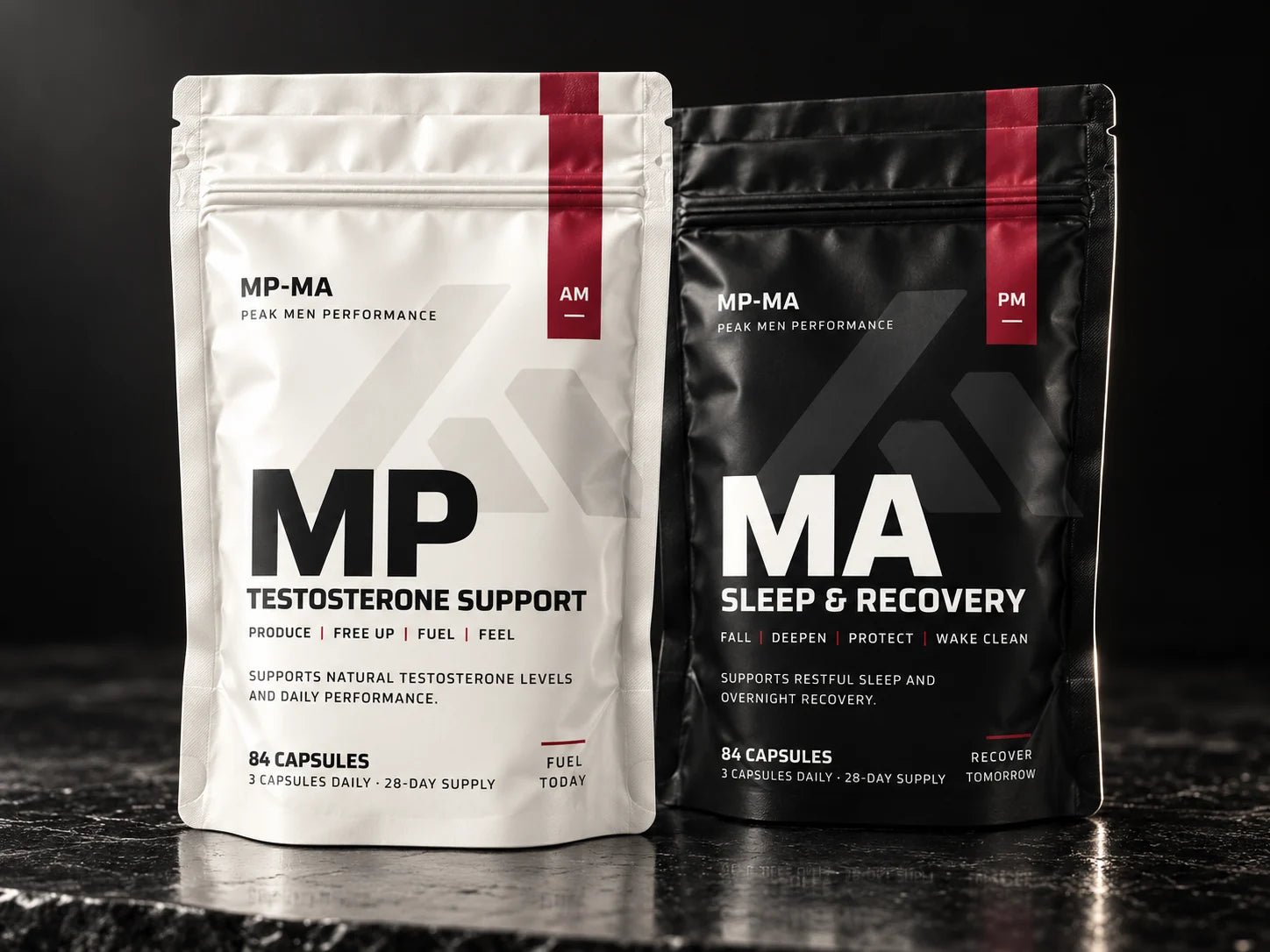
White MP and black MA pouches on a charcoal surface.

These studies tested individual ingredients or specific extracts. They did not test the complete MP-MA system. Matching an ingredient amount does not establish the same results for a finished formula.

Three different questions. Three different kinds of information.

01

What has been studied?

Ingredient studies examine specific extracts, amounts, populations, and outcomes.

02

What’s in the pouch?

The Supplement Facts label lists ingredients, amounts per serving, and serving size.

03

What has been tested?

Quality-control reports describe tests performed on identified materials or batches. They answer different questions from clinical studies.

SELECTED STUDIES

What the research tested.

Each card shows the study amount next to the amount on our label, per serving of 3 capsules.

L-theanine

L-theanine and sleep questionnaires

Hidese et al., 2019 · Randomized crossover trial · 30 adults · 4 weeks per treatment

Several sleep-questionnaire subscales improved compared with placebo. The overall sleep-quality score did not show a statistically significant between-treatment difference.

Study amount
200 mg L-theanine per day
Label amount
MA: 200 mg L-theanine per serving

Context: The named ingredient and amount match the label. This small trial tested L-theanine, not MA. The ingredient supplier funded the study.

Read the study
Ashwagandha

Ashwagandha and resistance training

Wankhede et al., 2015 · Randomized placebo-controlled trial · 57 men randomized · 8 weeks

Men with little resistance-training experience completed a training program. The extract group showed greater strength gains and improvements in some secondary measures compared with placebo.

Study amount
300 mg ashwagandha extract twice daily
Label amount
MP: 300 mg; MA: 300 mg per serving

Context: The combined label amounts total 600 mg. Neither pouch alone provides the study’s daily amount. Fifty participants completed the study; MP-MA was not tested.

Read the study
Ashwagandha

Ashwagandha and stress measures

Chandrasekhar et al., 2012 · Randomized placebo-controlled trial · 64 adults enrolled · 60 days

Adults reporting chronic stress showed improvements in stress questionnaires and morning serum cortisol compared with placebo.

Study amount
300 mg ashwagandha extract twice daily
Label amount
MP: 300 mg; MA: 300 mg per serving

Context: The combined label amounts match the daily ingredient amount. This does not establish the effects of MP-MA or an evening-cortisol benefit.

Read the study
Magnesium

Magnesium bisglycinate and reported sleep difficulties

Schuster et al., 2025 · Randomized placebo-controlled trial · 155 adults enrolled · 4 weeks

The study found a modest improvement in an insomnia-severity questionnaire compared with placebo, with a small effect size.

Study amount
250 mg elemental magnesium per day
Label amount
MA: 150 mg elemental magnesium per serving

Context: MA contains a lower amount. The study assessed reported symptoms and does not establish an increase in deep sleep or the effectiveness of MA.

Read the study
Saffron

Saffron extract and subjective sleep quality

Lopresti et al., 2021 · Randomized placebo-controlled trial · 120 adults · 28 days

Adults dissatisfied with their sleep reported improvements in some sleep measures compared with placebo. Other measured outcomes did not differ significantly.

Study amount
14 mg or 28 mg saffron extract per day
Label amount
MA: 30 mg saffron extract per serving

Context: The label names the same extract, at a different amount. This study did not establish objective deep-sleep changes or test MA.

Read the study

Where context matters.

An ingredient name alone does not tell the whole story. Different extracts, amounts, and starting conditions can change how a study relates to a formula.

Tongkat Ali: extract differences

A four-week trial in moderately stressed adults studied a standardized tongkat ali extract at 200 mg per day and measured salivary hormones and mood. MP lists a tongkat ali root extract at 300 mg per serving. These are different named extracts and amounts, so this publication is background research rather than an exact match to MP.

Vitamin D: starting levels matter

A 2011 analysis in men with low vitamin-D levels reported testosterone increases from baseline with 83 mcg daily over one year. A 2017 trial using 20,000 IU weekly found no testosterone treatment effect in men with normal baseline testosterone. MP lists 100 mcg daily. These findings do not establish a general testosterone-boosting effect for MP.

Zinc: deficiency is a specific context

A small study examined zinc restriction and supplementation in men, including older men with marginal zinc deficiency. The supplementation used approximately 30 mg elemental zinc as gluconate daily. MP and MA each list 15 mg as bisglycinate. This research does not establish a testosterone increase in men who already have adequate zinc status.

Glycine: amount and form differ

A small sleep-restriction study used 3 g of glycine before bed and assessed next-day fatigue and performance. MA lists 1 g, including 925 mg as a bisglycinate ligand and 75 mg free-form glycine. This is not the same amount or formulation, and the study does not establish a deep-sleep benefit for MA.

Check the formula details.

Review the full Supplement Facts for MP and MA, including serving sizes and ingredient amounts. For questions about product specifications or quality-control documentation, contact the MP-MA team.

See what’s inside MP + MA.

Explore both formulas, their full labels, and the day-and-night system.

Explore the system

This page summarizes selected ingredient research for educational purposes. Study findings depend on the extract, amount, participants, and methods used. They are not a guarantee of results with MP or MA. Follow the product directions and consult a qualified healthcare professional if you have questions about suitability, medications, or a medical condition.

These statements have not been evaluated by the Food and Drug Administration. MP-MA is not intended to diagnose, treat, cure or prevent any disease.