- Ashwagandha is one of the few herbal ingredients with randomised human trials behind it for stress, testosterone and recovery.
- In stressed and resistance-trained men, studies have linked it to lower cortisol and modestly higher testosterone.
- It works largely by lowering stress - which is why the benefit shows up most in stressed or overtrained men.
- Root extracts standardised for withanolides, taken consistently for 8+ weeks, are what the research actually used.
Ashwagandha has gone from an obscure Ayurvedic herb to one of the most talked-about ingredients in men's supplements - and for once, the hype has some real research behind it. This guide explains what ashwagandha is, what the human studies actually show for testosterone and stress, how it works, and how to use it sensibly.
What is ashwagandha?
The active compounds are called withanolides, and the root extract is the part with the strongest research. "Adaptogen" simply means it is thought to help the body adapt to stress - and stress is central to why it affects testosterone.
Ashwagandha and testosterone: the evidence
This is where ashwagandha stands out from most herbal ingredients - it has actual randomised, placebo-controlled human trials:
- In resistance-trained men following an 8-week program, ashwagandha supplementation was associated with significantly greater increases in testosterone, muscle strength and muscle size versus placebo (Wankhede et al., 2015).
- In chronically stressed adults, an ashwagandha extract was associated with lower cortisol and, in men, higher testosterone compared with placebo over 8 weeks (Lopresti et al., 2019).
The honest framing: the testosterone increases are real but modest, and they show up most clearly in men who are stressed or training hard - not as a dramatic overnight spike.
The stress and cortisol link
Cortisol and testosterone tend to move in opposite directions - chronically high stress suppresses testosterone. Much of ashwagandha's benefit appears to come from this angle: by helping lower cortisol, it removes some of the brake that stress puts on your hormones. That is also why the men who benefit most are the stressed and overtrained ones.

How it actually works
Beyond lowering cortisol, ashwagandha has been studied for supporting sleep quality and calm without heavy sedation - and because so much testosterone is made during deep sleep, better rest is a plausible secondary route to its hormonal effects. In short: less stress, better sleep, better recovery - and testosterone benefits from all three.
How to use it
- Form: use a root extract standardised for withanolides - that is what the trials used.
- Timing: many people take it in the evening, where its calming effect also supports sleep; consistency matters more than exact timing.
- Duration: give it at least 8 weeks - the studies ran 8 weeks or longer.
- Safety: generally well tolerated in trials; if you have a thyroid condition, are pregnant or take medication, check with your doctor first.
What to realistically expect
Ashwagandha is one of the better-studied natural ingredients for men - but it is support, not a drug. Expect a gradual effect on stress, sleep and recovery over weeks, with modest testosterone benefits most noticeable if you are stressed or training hard. It works best alongside the fundamentals: sleep, strength training and a sensible diet.
Where MP-MA fits
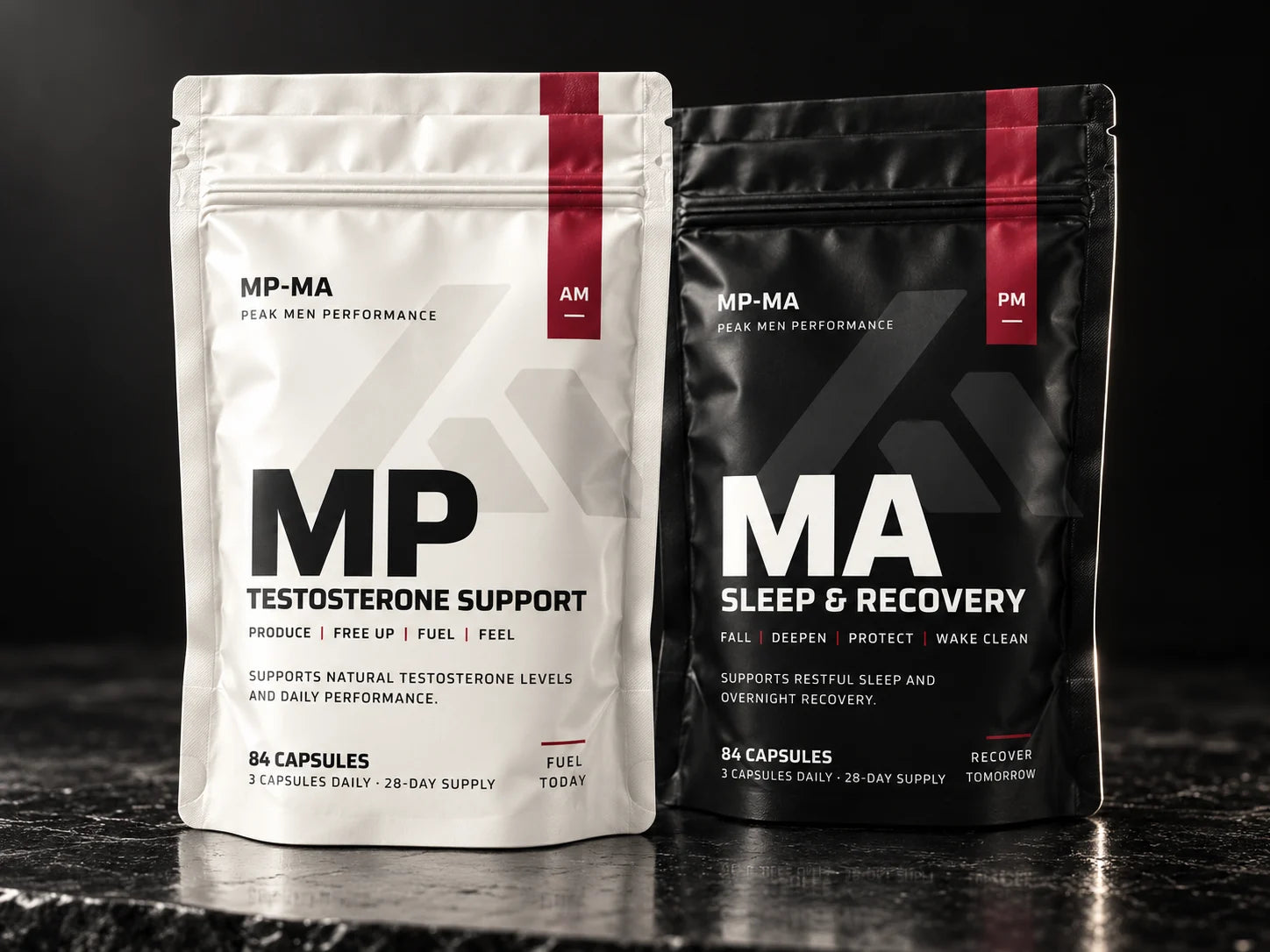
MP-MA includes a studied dose of ashwagandha root extract in the night-time MA formula, paired with magnesium, glycine and L-theanine to support the deep sleep and recovery where testosterone is made - every dose on the label, no proprietary blends. See the research on our science page or explore the MP-MA Day & Night System.
Frequently asked questions
Does ashwagandha really increase testosterone?
Randomised trials in stressed and resistance-trained men have linked it to modestly higher testosterone, largely by lowering stress and cortisol.
How long does ashwagandha take to work?
The studies ran 8 weeks or more. Expect a gradual effect on stress and recovery over that period rather than an immediate change.
When should I take ashwagandha?
Many men take it in the evening, where its calming effect also supports sleep. Consistency matters more than exact timing.
Is ashwagandha safe?
It was generally well tolerated in trials. If you are pregnant, have a thyroid condition or take medication, speak to your doctor first.
Sources
- Wankhede S, et al. Examining the effect of Withania somnifera supplementation on muscle strength and recovery: a randomized controlled trial. J Int Soc Sports Nutr. 2015. PubMed
- Lopresti AL, et al. An investigation into the stress-relieving and pharmacological actions of an ashwagandha (Withania somnifera) extract. Medicine. 2019. PubMed Central
- NIH Office of Dietary Supplements - Ashwagandha fact sheet. ods.od.nih.gov
- MP-MA. The science & full reference list. mp-ma.com/pages/science
These statements have not been evaluated by the Food and Drug Administration. This product is not intended to diagnose, treat, cure, or prevent any disease. This article is for general education and is not medical advice.